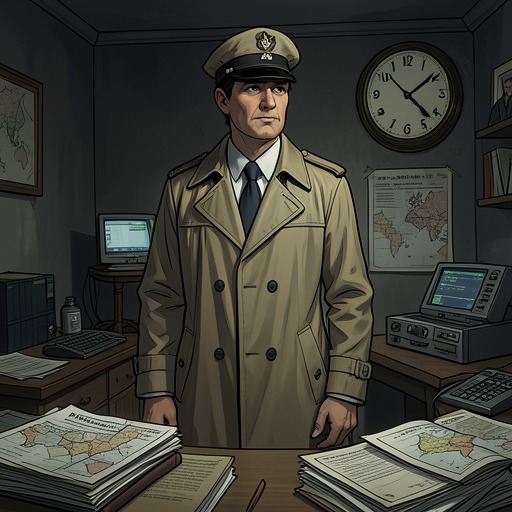
FBI CPZ drug-marker program
Dead ShotThe FBI CPZ drug-marker program is a covert drug-network tracking scheme whose central idea is to mark methamphetamine with a chemical that produces an unusual medical signal. That signal is reported to the Centers for Disease Control and Prevention, allowing the Federal Bureau of Investigation to identify the reach of a dealer’s distribution network. In Statenville, however, the program becomes inseparable from institutional secrecy, experimental misconduct, and the deaths of three young people, including Riley Gold.
Purpose and Operating Logic
The program was conceived as a way to follow drugs through a criminal supply chain rather than merely seize one shipment or arrest one dealer. The FBI planned to place CPZ markers in individual doses or random batches of drugs. A user who developed the unusual symptoms would come to medical attention; the case would then alert the Centers for Disease Control and Prevention, from which the Federal Bureau of Investigation could obtain basic information about the spread of a dealer’s network. The intended result was a map of distribution: the marker would identify where the product traveled and help investigators connect street-level users and dealers to a larger operation.
The method had already been tested in 2008 by undercover operatives in Seattle, Los Angeles, and Phoenix. Each field test ended with the drug user dying, although the report available to Cal Murphy did not specify the cause. The program was consequently disbanded because the FBI did not want the publicity associated with a surveillance method that killed its test subjects, even if the method might help eliminate drug pushers. Its history establishes that the danger was not an unforeseeable discovery in Statenville; the agency had already encountered fatal outcomes and formally abandoned the program.
From Bureau Research to Statenville
The program returned through the Federal Bureau of Investigation’s deep-cover operation against Deangelo and Cloverdale Industries. Walker and Mercer were placed in Statenville to gather prosecutable evidence against the drug operation and the people who sold and transported its products across state lines. Their assignment was broader than bringing down one manufacturer: the FBI wanted evidence against the entire network, including those moving Cloverdale’s drugs through the Pacific Northwest.
Walker, who had a minor in chemistry, became convinced that he could overcome the limitations that had caused the official research to fail. The animal testing had already shown the ethical and biological danger of the marker. Monkeys had reportedly torn at themselves and died, while dogs scratched and clawed themselves to death; officials concluded that the idea might work in theory but was not ethically acceptable for human testing. Walker nevertheless pressed ahead, and Mercer eventually relented. Their covert operation thus crossed a decisive boundary: an abandoned bureau experiment was reintroduced not through an authorized protocol, but through the initiative of an impatient agent seeking a major breakthrough.
At first, Walker could not insert enough chemical into a shipment to make the distribution visible to federal monitoring. The small amount he used could not reliably identify an entire load or its destinations. He then changed the method by placing the marker into drugs found in Riley Gold’s car. The coaching staff knew that several players had begun using drugs, making Riley an accessible target for observation. Walker expected to watch Riley and other teammates take the marked product and then use the resulting cases to trace the network. He did not adequately reckon with the possibility that his compound could kill them, despite Mercer’s warnings.
The Chemical and the Deaths
The marker was meant to produce what appeared to be the sudden onset of a rare disease, prompting medical reporting and a federal alert. It was not supposed to be fatal. In practice, a rogue FBI agent altered the additive so that it forced liver bile into the bloodstream quickly, producing uncontrollable itching beneath the skin. The victims were already high from methamphetamine when the symptoms began. They scratched themselves to death, transforming the marker’s intended medical anomaly into a mechanism of torment and murder.
The consequences were first disguised as ordinary overdoses. The three local high-school football stars were found dead in gruesome circumstances, and residents were told that methamphetamine itself had killed them. Local law-enforcement officials pressured the coroner’s office to issue falsified reports, preserving the appearance that Statenville had suffered a series of drug overdoses rather than deaths caused by a federal chemical operation. Riley Gold’s presence among the victims made the concealment especially dangerous: the program had killed the son of Deangelo, the man the FBI was trying to expose.
On Tuesday, an independent examination by FBI officials established that the methamphetamine was not itself the cause of death. The fatal agent was the marker mixed into it. That finding changed the meaning of the deaths from a local drug tragedy to evidence of a covert operation gone catastrophically wrong. It also connected the students’ deaths to the federal investigation and made the marker a piece of evidence against both the drug network and the agents who had used it.
Exposure and Moral Consequences
The CPZ program is disclosed to Cal Murphy as an explanation for the strange deaths and for the FBI presence in Statenville. Cal learns that Walker and Mercer had been using the marker to build a case against Cloverdale Industries, while Gold is told that the same operation placed the chemical in the drugs his son consumed. The disclosure therefore works on two levels: it explains the investigative method and reveals the human cost hidden beneath official language about surveillance, evidence, and network mapping.
Mercer remains the surviving source of incriminating information about Gold and the only living person who had participated in the part of the operation that caused Riley’s death. He tries to separate himself from Walker and present himself to Cal as a compromised but fundamentally different participant, arguing that Walker acted recklessly while Mercer wanted the truth reported in a way that would make him appear heroic. The program’s aftermath consequently includes not only exposure of Cloverdale Industries, but also a struggle over responsibility: Walker engineered the deadly effect, Mercer helped insert the chemicals, and local officials helped conceal the resulting deaths.
Cal’s eventual article places the marker within the public account of the Statenville case. The published report explains that the FBI had deployed two deep-cover agents against Deangelo and Cloverdale Industries, that the three deaths had been falsely labeled methamphetamine overdoses, and that the marker rather than the drug itself caused the fatalities. It further identifies the marker’s intended purpose as tracking the reach of the criminal network while recording that its altered chemistry killed the victims. Journalism becomes the route by which a hidden technical procedure, suppressed medical evidence, and a compromised federal operation are assembled into a comprehensible public record.
Significance
The FBI CPZ drug-marker program embodies the novel’s contrast between an apparently rational investigative system and the uncontrolled consequences of using people as instruments. Its original design promises visibility: a chemical signal will make an invisible drug network legible to federal investigators. In Statenville, that promise is corrupted by secrecy, unauthorized experimentation, inadequate control over the compound, and the willingness of officials to suppress the resulting evidence.
The program also exposes the difference between technical intention and actual responsibility. The marker was not designed to kill, yet the deaths cannot be dismissed as a neutral accident because agents revived a known-dangerous program, altered the substance, selected vulnerable targets, and continued operating inside a system that concealed the results. Riley Gold and the other two student-athletes become collateral damage in an investigation that claimed to serve public safety while reproducing the violence it sought to document.
Its final significance lies in the way it links science, law enforcement, organized crime, local government, and the press. Cloverdale Industries supplied the criminal network being traced; the Federal Bureau of Investigation supplied the covert intervention; Walker and Mercer converted the intervention into a lethal experiment; local officials falsified the explanation; and Cal Murphy’s reporting finally made the chain visible. The CPZ marker therefore does more than identify the reach of drugs. It reveals how institutions manufacture evidence, conceal failure, and decide whose suffering will count as public knowledge.